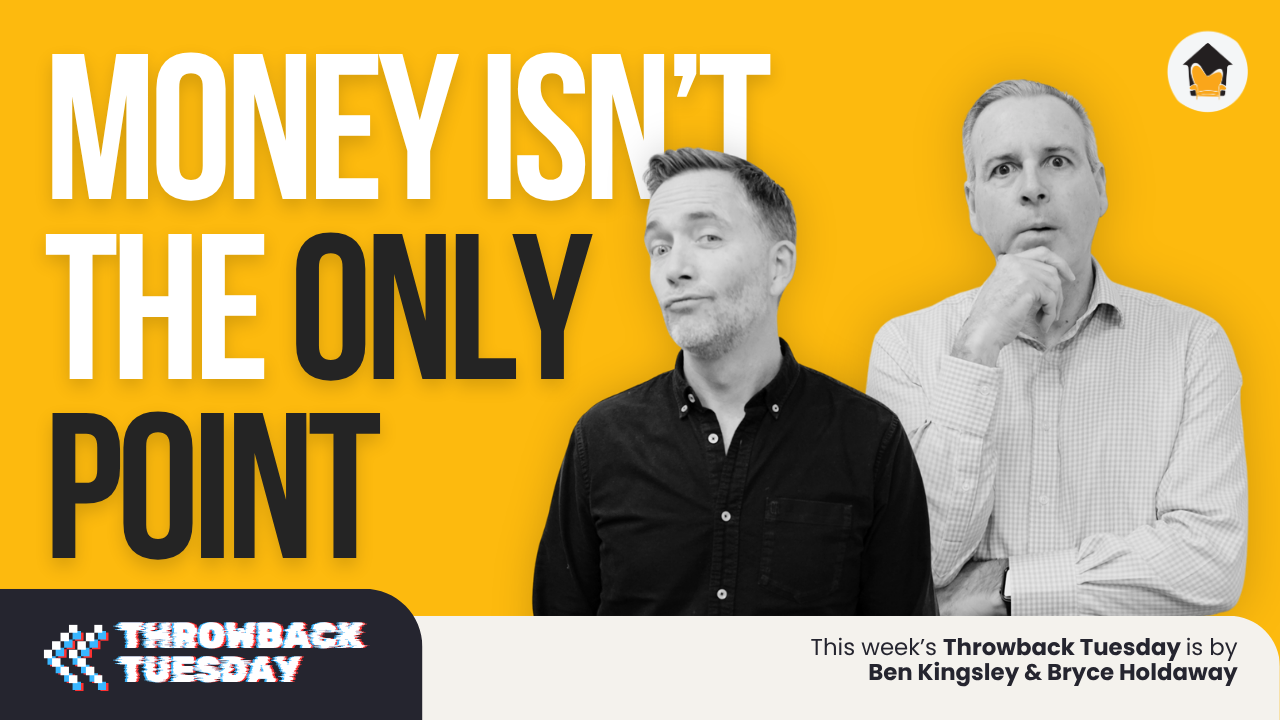
This snippet is from one of our previous episodes: Journey of the Property Investment Advisor of the Year.
Let’s rewind the clock to one of our favourite moments on The Property Couch!
In this TPC Gold episode, we revisit a timeless chat with our very own Ben Kingsley — recorded just after he won Property Investment Advisor of the Year for the second year in a row.
While the awards are worth celebrating, what makes this conversation truly evergreen is the insight into why great property advice matters, and how to spot it.
Ben and Bryce unpack what actually happens in that first meeting with a professional property investment advisor, the mindset shifts that change the game for investors, and the difference between strategy and spruiking.
Ready for your own ‘aha’ moment?
If this episode hit home and you’re keen to stop second-guessing your next move, now’s the perfect time to chat with Empower Wealth’s award-winning team.
We’ll help you build a property investment strategy tailored to your very own goals.
__________________
If You Enjoyed TPC Gold | The Truth About Good Property Investment Advice, You Might Also Like:
- Ep 1 | We Fix Bad Property Investment Advice
- Ep 503 | How to Get the Right Property Investment Advice
- Ep 520 | Should You Take Property Advice from a Financial Planner?
Transcript
Bryce Holdaway
Every week I introduce us by name, rank and title… just in case someone’s listening to us for the first time. And they can understand who they’re talking to. But I always say the Property Investment Advisor of the Year for you. Now I can actually say the reigning and current Property Investment Advisor of the Year. Cause mate, you just took out the award for the second year in a row back-to-back.
Ben Kingsley
I did; I did. Thank you very much. For those of you who don’t know what this award is, there’s not too many awards out there for property investment advisors. In fact, this is probably the number one award. It’s done by Your Investment Property magazine. And yeah, it’s basically feedback that they receive from satisfied clients and then it’s peer review of that feedback, and then they make a call on who gets the chocolates.
Bryce Holdaway
What? I’ve been dialing 0055 numbers for you, texting my vote in. I’ve probably spent a couple hundred thousand dollars on voting. And it meant nothing?
Ben Kingsley
Well, that’s only small change for you.
Bryce Holdaway
So, it’s not a popularity contest? It’s actually someone who knows what they’re doing (that) actually gets rewarded.
Ben Kingsley
Correct, and there’s a few out there that are popularity contests… so I don’t necessarily chase those. But that’s nice to know, and I’ve got to say that this is not my award. It’s obviously everyone that helps me do what we do.
Bryce Holdaway
Here we go, Captain Humble.
Ben Kingsley
Well, it’s important to understand that I’ve advised now on I think around $750 million dollars’ worth of property investment plans… and you just simply can’t do that by yourself. So yep, as much as I’m here pretty much 70 hours a week, there’s a great team of people who do that. So, shoutout to Joel and Michael Pope and the team here at Empower Wealth. They do a great job.
Bryce Holdaway
Yes, I totally agree with you, but what I do want to say to the listeners is that Ben has some very strong thought leadership. I often wonder how he functions, the amount of sleep that he has, and the ideas and philosophies that he has very much permeates through the culture of our business here. So he is very humble and he does have other people that do help him do what he does… but I think it’s a really significant award because there was Buyer’s Agency of the Year awards, there was Property Manager of the Year awards, there was Tax Agent Advisor of the Year. But given in our view (and we’ve said it almost to the point of being a broken record) that we feel too many property investors get stung in that environment. And that is a backdrop for you to be able to win that. It’s pretty good.
So I thought today we might actually try and unpack a little bit for the benefit of the listeners. If they’ve been listening for the last 35 episodes, they will get undertones and undercurrents of your philosophies and your thoughts as to how you build a portfolio. But when someone walks into the office, what do you think is the number one message that you’re trying to get across to them? Because let’s be honest, the levers that you talk about are quite straightforward in your mind. But is there anything that you feel that you need to overcome with a client? Or is it more about mindset that you’re trying to get them to a place where you probably know what they need to do within the first five minutes, but the rest of the hour is to get them to come up to speed with what you’re trying to do?
Ben Kingsley
I mean, technically people should come in a little bit conservative, a little bit unsure. Ultimately, we’re a business and we get paid for the work that we do. So naturally there’s a tendency for not having trust and that sort of rapport. So the most important thing I do with people is to sort of say: look, this first hour (I usually give a complimentary hour to anyone who’s willing to put some information together for me, so I can give some tips straight up) is really just around getting them to understand that there are a lot of moving parts. And if property investment was easy, then everyone would do it and do it well. But it’s not. A lot of people do it but do it poorly. So I think the most important thing for me is around understanding the moving parts. So for us, that’s about the process.
That’s about the science, it’s about the formulas, and it’s all about putting all of that together. And there is absolutely big things on mindset, money management, structuring, strategy, implementation, tactics, formulas, processes, asset selection. So there is a lot to learn. I mean, this is a half-a-million-dollar transaction most of the time, if not more. In some cases, we’re refinancing, restructuring, getting them fit to actually operate in the property investment arena. So I think from that point of view, that’s probably where it shouldn’t be solved in an hour. In fact, to do a property plan with myself or one of my team, it’s a 20-hour process. That’s roughly what it takes. And that’s usually around five or six hours of contact time face-to-face or for our interstate and overseas clients, it’s about having that conversation with them via Skype or go to a meeting or whatever we use.
That’s the most important thing for me. It’s about what that money’s gonna do for them. So property is but a vehicle. I was actively into shares from the age of 16 and I was trading shares and sort of working out the best fit for me as I was learning more about my comfort levels and my mindset to money and building that knowledge up. And as you build that knowledge up, you get more and more comfortable with it. And you move from a position of procrastination and scared, to a movement of confidence and assurance in terms of what you’re doing. So I think I’m answering this in a long, long-winded way, but the reality is there are lots of moving parts. And so making sure we do that and then align it back to their goals i.e. why are they doing this?
So there’s tangible reason. Because if you don’t have a tangible reason, the reality is you’ll probably change tack. And then trying to unpack what those tangible reasons are. Whether it’s: I want to supply an income for my family in the future. I to build a legacy for the next generation. I want to go on great holidays. I’ve got my bucket list. We know we want to get a bigger home… All of those things are important, and when you’re doing a property investment plan a lot of those plans actually include a new owner-occupied property. So it’s not just about focusing in on one property, it’s about sort of saying how do we plan this out and how do we focus on getting the big rocks in the jar.
Bryce Holdaway
I think that’s probably one of your strengths, isn’t it? That you look at the bigger picture of, well, first of all, the why, so that we can actually start from there… but also take into account the realities that people have in their life. School fees, renovate the kitchen, go on a significant holiday. Because let’s be honest, until I met you many years ago, the idea of what a strategy really looked like is the “advisor”, and I’m doing inverted commas here for the listeners. They look at your, I guess, balance sheet. Their eyes would light up, see that you’ve got equity, and the strategy is simple: you’ve got to buy a property.
Ben Kingsley
If you’ve got $80,000 and equity in your family home, we can help you get into property investing. Yeah. Blah, blah, blah.
Bryce Holdaway
That’s a career in voiceover. You can’t start the podcast, but at least you’ve got a career in voiceover. So when someone walks in, what do you think their biggest aha moment is once they’ve spent the time with you understanding the process and they spend an hour to an hour-and-a-half with you? What do you think the number one aha moment is for those people, based on the paradigms they had when they walked in and then after the 90 minutes?
Ben Kingsley
I’d like to think it’s that: Ah, he’s on my side. He’s going to be part of a professional team that’s going to help me be the best that I can be, and have the best results I can get. As an active professional investor myself, I still take advice and I’m still learning. But if the aha moment is that: wait a minute, he knows what he’s talking about and he’s gonna be in my team… it just makes perfect sense that I’m gonna leverage from his knowledge, leverage from his skill, and leverage from all of the information he can provide.
Bryce Holdaway
And you’re trying to be in the same scene, in the same breed of professionals that someone would go to their account each and every year for review. They go to their solicitor. In fact, they go to their hairdresser. They go back for a regular service and see him as a trusted advisor.
Ben Kingsley
Yeah, absolutely. When you’re building out a full portfolio plan, which is a multiple property strategy, or we can build a one-off investment plan. You know, what’s the next thing I can do? What’s the next best move for me? Or we do a full portfolio plan, which is reverse engineering from a certain date in time and then an income target. So once I understand all of that, I can then obviously articulate what that means in terms of the big rocks in the jar.