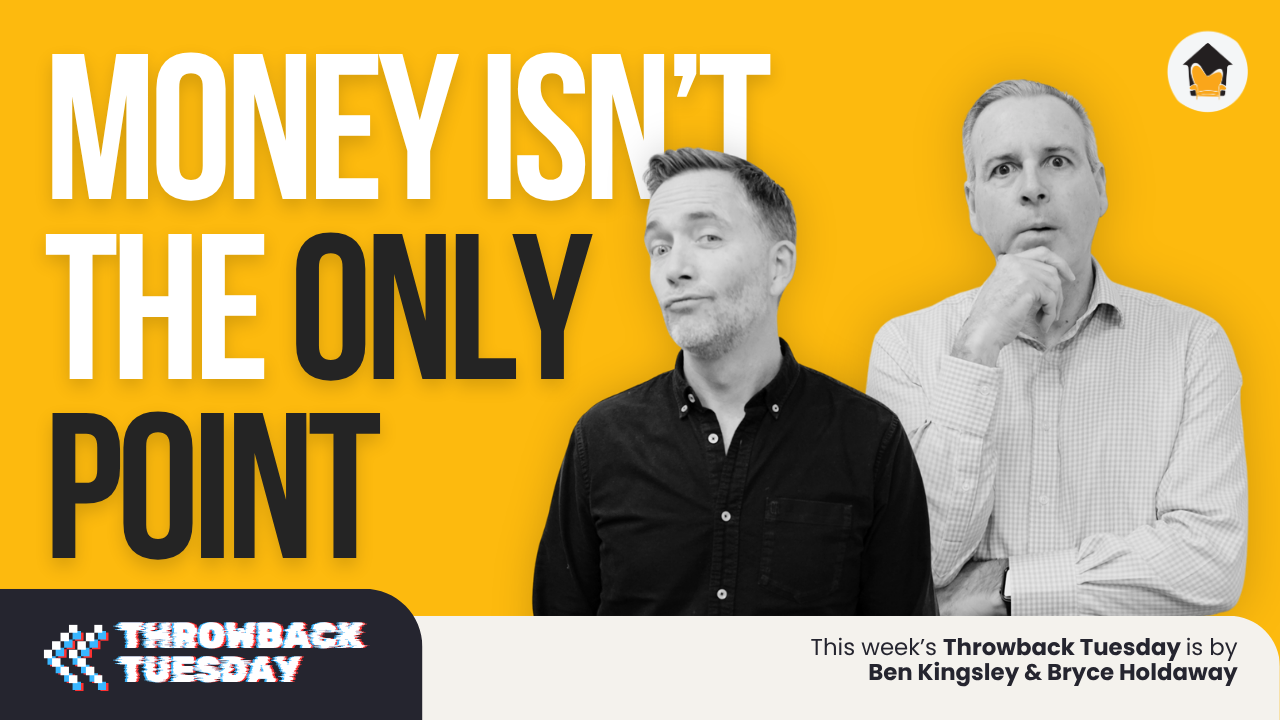
This snippet is from one of our previous episodes: The 4 Pillars of Money Health.
If you’ve ever built a budget, felt good about it… and then completely ignored it a week later — you’re not alone.
The truth is, most budgets don’t fail because the numbers are wrong. They fail because they rely on perfect behaviour in imperfect moments.
As Ben and Bryce unpack in this TPC Gold snippet, managing money isn’t just about spreadsheets, categories, or tracking every dollar. At its core, it’s a behaviour game.
Because when you’re sitting at home on a Sunday night, reviewing your budget, everything feels easy. You’re calm, rational, and in control. Of course you’ll stick to your plan.
But that’s not when real decisions happen.
Real decisions happen at the checkout — when you’re tired, hungry, or when something feels like a “small” purchase.
That’s when your spreadsheet isn’t there to guide you.
At the end of the day, it’s about building habits that support your decisions — especially in those small, everyday moments that most people overlook.
And once you get that right, everything else starts to follow.
Spreadsheets Don’t Change Behaviour… Systems Do.
Want to put the MoneySMARTS system into action? Moorr is the platform that brings it to life — helping you structure your money, automate your habits, and stay in control day to day.
Create your free account at www.moorr.com.au.
__________________
If You Enjoyed TPC Gold | Why Your Budgeting Spreadsheet is Failing You, You Might Also Like:
- TPC Gold | Dumb Things Smart People Do With Their Money
- TPC Gold | How We Teach Our Kids About Money—Saving, Spending & More!
- TPC Gold | Why We Swear by the Seven-Day Float
Transcript
Ben: If you don’t have money controls and you don’t have a money management system doing that for you, and you don’t discover any lazy money, well, you’re not really being honest with yourself. I mean, with the level of experience that we’ve got, I can go through any household and basically find opportunities for those households to improve.
In the MoneySMARTS system, one of the great concepts is essential versus discretionary. So everyone goes, “Oh, my grocery bill was $230 a week.” Okay, that’s $230 a week — but how much of that is essential? How much of that is discretionary?
“What do you mean? Well, it’s the grocery bill — isn’t it all essential?”
Is it? Is it really? Is the punnet of ice cream, the sweets, the soft drink — are all of those essential needs, or are they discretionary?
Now, we’re not challenging people unfairly here. For some households, they make the choice — that’s what they want. They want to live. They don’t want to be living on crackers and Vegemite until they’re 55 and only then start enjoying the wealth they build.
That’s fair.
But understanding that there is potentially some wriggle room between what is essential and what is discretionary can have a material benefit — especially for those people who say, “I just can’t find any spare money in the budget. I just can’t find any opportunity to build on that.”
That’s really what’s essential around the concept of bills and spending, and the seven-day float — getting people into those rituals, those daily habits, and then those monthly habits that we train in a good money management system.
Because a good money management system must be rules-based — and the rules need to be fairly easy to follow. They don’t need to be too complex.
And when you have a platform or a system to help you do that, it just becomes so much easier.
Bryce: Yeah, Ben, I think the rules-based system you just talked about is really important.
Yesterday, I was down at the local retail store — I live in Torquay, it’s no secret, and it’s cold down here — so I needed to buy a jacket.
Here’s the visual I want everyone to land on: when I’m tapping the card to make that purchase, is it a human making that decision, or is it a spreadsheet making that decision?
It sounds straightforward — clearly it’s a human. But it’s important for people to realise that the spreadsheets are not with you at the point of sale when you’re making the decision. It’s all about controlling behaviour.
I’m very clear that I’ve provisioned money for that jacket. And I’m very clear on how I deal with that at the end of the month, where I allocate that towards the provision. So I know that I’m swimming between the flags.
But that’s the important part here — the whole game of money is a behaviour game.
Because if it wasn’t a behaviour game, every single person who’s ever written a budget would say, “Yep, at the end of the month I said I’d have 50 bucks, and I did.”
But there’ll be people listening to this nodding, going, “Yeah, I’ve done budgets before. I’ve put plenty of time and energy into them at the time of making them — but at the point where it really mattered, they were nowhere to be seen.”
And then they didn’t want to reconcile it at the end of the month because they were too far off.
So this is why we say this is a pillar of financial stability. The reason it’s important is — if you go back to James Clear, which was an episode we did in December 2019 — he said it’s the habits you do on a daily basis that get you to your bigger goals.
So what we’re talking about here is habits.
How do you make decisions at the time when it matters most? Because when you’re sitting in front of your spreadsheet on a Sunday night, when you’re not in the throes of making a transaction, it’s easy to stay on budget.
But when you’re in the coalface — facing temptation, marketing, all the noise being thrown at you — that’s when it matters. That’s why stability comes from this pillar — having MoneySMARTS in place.
Do you have a system to guide your behaviour? Do you have something to lean on when you’re about to make a spontaneous decision — whether you should or shouldn’t?
Do you have something that helps you when you’re at your most vulnerable — when you’re hungry, or when you feel like you need something?
That’s when it matters most.
So yes, we labour the point — and we have a strong passion for people doing MoneySMARTS — but at its core, it’s a behaviour management system.
It’s got spreadsheets, rules, numbers, allocations, provisions — all of those financial things — but at its core, it’s behaviour management.
Ben: Yeah, I think there’s a really good message in that.
We talk about spending slippage. And it’s not necessarily the big-ticket items sometimes — but when it is, it can be significant.
If we go shopping for a TV with a budget of $1,000 and walk out with a $3,000 television — that’s material.
That has a huge impact. We call that consequential finance — our internal terminology. The question becomes: how much is that going to push out my retirement? Or how much is that costing me in lost opportunity — money that could’ve been sitting in my offset, saving interest?
But slippage also happens every week.
That’s why we have the seven-day float — the living and lifestyle account. We separate that money from the rest of the money in the primary account because the reality is, you don’t have your spreadsheet with you.
You just want to know: how much have I got left?
That’s why it’s a separate account — so you can quickly check your phone and see, “Okay, there’s $80 left. I can make this purchase — it’s part of my regular spending.”
I’ll give you an example, Bryce.
On Sunday morning, I woke up and we didn’t have enough milk. So I thought, “This is my window — I’ll head out, grab some milk and bread before the family wakes up.”
I’m at the shop, standing in the queue, and there’s a lady with her young child. You know how it is — all the fun stuff is right there at the checkout.
The child — probably three or three-and-a-half — sees the little cars…
Bryce: Hot Wheels.
Ben: Hot Wheels, that’s right.
So there’s this display full of Hot Wheels, and the child is asking, “Mum, Mum, Mum — can I have one?”
Now here’s what was fascinating — it’s only $3.25 or $3.50. She says, “Alright, you can have one.”
While the child takes 90 seconds picking one out and everyone’s waiting in the queue, she starts making small talk with the cashier. She says, “He’s already got about a hundred of these at home.”
And for me, that’s the moment — you keep the child happy at the checkout, but the joy of that toy lasts maybe two minutes. Then it’s just added to the other hundred at home.
So where’s the value in that?
And if that behaviour repeats — with soft drinks, snacks, all those little things — that’s where the slippage happens. That wasn’t a planned purchase.
Now, I get it — you want to treat your children. I’ve got a nine-year-old and a ten-year-old. I know the game — they wear you down, they justify why that toy is the most important thing in the world right now.
They’ll tell you if they don’t get it, no one will be their friend at school — they’ll sit in the corner crying.
I get the emotional side of it.
But what we’re highlighting is this: sometimes it’s about having techniques — distraction, changing the conversation, focusing on what’s next — to move their attention away from that constant consumer pressure.
Because that’s where the slippage is.
You don’t want to feel like a bad parent — I get that. I’m often “Mr No” in our household — but I’m trying to teach the value of money.
You don’t just walk into a shop, tap a card, and assume it’s endless. You have to give your time to earn that money. So these tools are really about helping change habits and behaviours — and sticking to your guns.
*Transcript has been edited for clarity and readability.